Vlasta Žáková & Veronika Pátrovič Kočáriková: Invisible Worlds
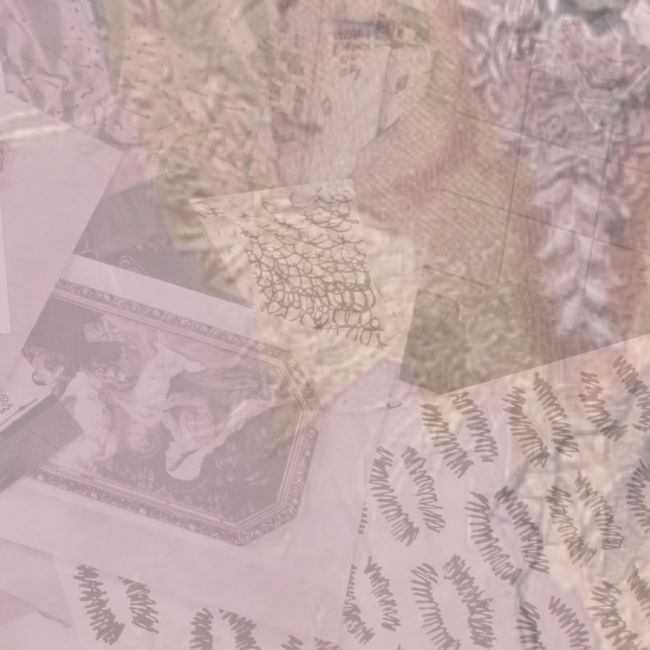
The exhibition Invisible Worlds at the Kysucká Gallery in Oščadnica presents a selection of works by two now established Slovak artists, Mgr. art. Vlasta Žáková ArtD. and Mgr. art. Veronika Pátrovič Kočáriková.
Kysuce Gallery in Oščadnica
They are connected by their current work at the Department of Textile Design in the Textile Design Studio at the Academy of Fine Arts in Bratislava. Textile material is transformed into a medium of memory, corporeality and personal experience in their works. Thread, embroidery and stitching in their works transcend the level of craft and become an expressive language – a trace of emotion, time and human touch.
For Vlasta Žáková, textiles often have the character of a pictorial, very personal statement. Fragmented figures, organic motifs and expressive thread drawings open up themes of vulnerability, pain and inner tension. The contrast between the delicacy of the material and the rawness of the content creates a strong visual and emotional tension. In a less exhibited series of textile paintings, the artist focuses on the environment of concrete residential structures – a gray architecture that becomes the backdrop for everyday situations, but at the same time carries a strong symbolic meaning. She explores what is probably happening behind their walls: invisible stories, tensions and silence that arise in a space where individuals gradually close in on themselves.
We see a critical reflection of the current pressure on female identity.
The second significant thematic line stems from the artist’s interest in “true crime” podcasts. Inspired by stories of unsuspected self-destruction, hidden acts and unseen violence, Žáková works with the image of the landscape as a crime scene. Natural motifs of moss, mushrooms and organic structures symbolically cover up what has happened – similar to how time and nature absorb traces of human tragedies. The woman appears here in an ambivalent position: as a victim, but also as a silent, undiscovered territory, carrying her own secret and inner vibrations, her own genius loci.
Both lines intertwine and complement each other in Žák's work.
They are united by the question of self-reflection - thinking about one's own life, about the degree of satisfaction, about what remains hidden from the gaze of others and from ourselves.
In her works, textile becomes a medium of silence, memory and invisible layers of reality that can only be suspected, but not completely revealed.
Veronika Pátrovič Kočáriková's work grows out of personal experience and sensitive observation of the environment that a person inhabits.
The author, currently a doctoral student in the studio of doc. M. A. Blanka Cepková, works with textile as a basic expressive medium - a material that can carry the memory of the body, place and time. The socially engaged dimension of her work also deepened during her studies in Scandinavia – in Denmark and especially in Norway, in Oslo, where she gained distance and a new way of thinking about the textile medium. This shift is reflected in her work with space, in her emphasis on process and in her ability to connect personal statement with a broader cultural context.
At the exhibition Invisible Worlds, she presents a selection of her current work and research, in which she connects clothing, object and installation into a multilayered, open statement.
At the center of her interest is the region from which she comes – Radošovce pri Skalice, a region of Záhorie with its own visual language and rhythm. Here, traditional clothing does not appear as a folklore artifact, but as a form of visual autobiography. Veronika works with fragments of the village environment, with its signs and memory, which she gradually abstracts and transforms. In her installations, fabric and canvas transform into spatial layers – similar to an onion, the structure of which reveals that identity, like a person, is created by the gradual accumulation of experiences.
The author touches on the transformation of tradition in the contemporary context.
The change of forms and technologies does not mean extinction, but a shift in meaning. The invisible work of women – silent, repetitive and time-consuming – remains present as a stable foundation, although it often escapes attention. She consciously connects traditional textile practices with modern technologies, thereby creating a tension between the past and the present, intimacy and distance.
Veronika Pátrovič Kočáriková’s works appear quiet and unobtrusive, but they carry an accurate statement about the relationship of a person to the place they inhabit. In her work, textiles become a medium for recording what remains hidden beneath the surface – layers of identity, memory of the region and everyday work that persists even when it is not visible. And the joint work of these two artists, as the title of the exhibition “Invisible Worlds” suggests, reminds us that in our world, what is often invisible has real value.
Mgr. Darina Arce