Video: Václav Cigler on artistic creation
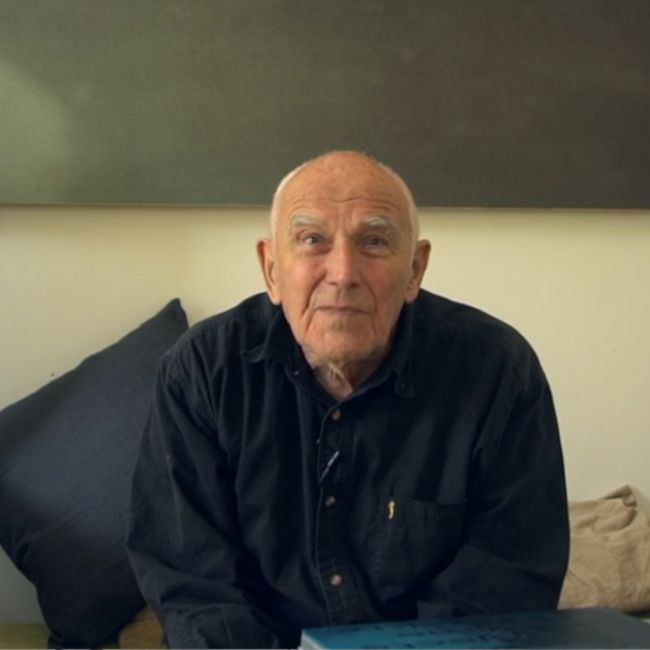
We present to you a recording of an interview from 18 May 2019, in which the glass artist talks about his work.
In 1965, Václav Cigler founded the Glass in Architecture Studio at our school, which he led until 1978. This studio was exceptional: it taught students not only glass art and glass technology in connection with architecture, but also encouraged them to reflect on art, on creation, and on the world in which we live.
The video is published in memoriam. Václav Cigler passed away on 9 January 2026
Funeral Address by the Rector
23 January 2026, Church of Our Lady of the Snows, Prague
Our Sun is one of the stars in the galaxy we call the Milky Way, which consists of one hundred billion stars. And there are at least another one hundred billion galaxies like ours in the entire universe. So in such a world, full of galaxies and stars, there are only the two of us, you and me.
Dear bereaved family, dear mourners.
In 1965, Václav Cigler founded the Glass in Architecture Studio at the Academy of Fine Arts and Design in Bratislava. At the age of 36, he began building the studio as a “laboratory of thinking, an experimental workshop, an environment for self-discovery.” He fulfilled these three universal values of education at an art school through a broad understanding of the artistic and technological possibilities of glass. The collaboration between the glass studio and the architectural studios at the school made it possible to perceive glass art in a much wider context. Work with technical glass, glass walls, or repeating glass blocks led not only to discovering a new sensibility of glass in architectural space, but also to conceptual thinking within the visual art of the time. Václav Cigler was legendary for his approach to students. He gave them the freedom to express themselves in their own way—through painting, poetry, drawing, or sound. What mattered, however, was the students’ integrity in thinking and in their approach. He often spoke about the need to discover, to experiment, to be courageous and take risks even with an uncertain outcome. From my conversations with him, I understood that he genuinely cared for his students; he devoted attention to them so that no one would fall behind and so that each could develop their talent in their own unique way.
In the favourable 1960s, he succeeded in placing the studio within the European context of contemporary artistic thinking, within the context of the late avant-gardes. The 1970s brought normalization and the pressures associated with it. Whenever I reflect on Václav Cigler’s work at our school, I find myself thinking more about the 1970s. It was a period that required a high degree of courage and determination.
I recall a slim collection of poems by Jiří Kolář entitled Days in a Year and Years in a Day. These were daily records of a demanding and inhospitable time. In the poems, the author sees a world driven by a single longing for freedom. He speaks of the Sun having set, and likely for a very long time—perhaps until the end of the century.
When days seem as heavy and as long as years, I think of the past. I think of periods immersed in shadow, of times that resemble twilight. And yet, I cherish these periods. For these times have their lights. There are not many of them. In time, these lights can grow stronger and push back the shadows. When this happens, few people notice them; few turn their heads toward them. But when the light intensifies and words speak urgently, then things begin to change. Dawn brings hope, cohesion, solidarity, and determination. This moment is extraordinarily beautiful and rare—and today we are fully living it at our school. And this is also thanks to Václav Cigler. I deeply value his example of leading a studio that remained free despite constant normalization pressures. It is my compass for how to lead a school, how to create together with colleagues a safe, supportive, and kind environment in polarized, radicalized, and autocratic times. Václav Cigler led his students not to be afraid, not to be cowardly. He knew that only in this way is it possible to create freely and authentically. Only in this way is it possible to live a good and fulfilled life.
In one of my last conversations with Václav Cigler, we spoke about what it means to be born again during one’s lifetime. About what it means to continually rediscover oneself, to become present again in a changing world and time. In one of his poems he writes:
“we are … in order to become present,
not so much to ourselves, but to that which we are beyond.”
I am deeply convinced that this becoming-present is a transferable experience. The spiritual presence of important people in our lives helps us move toward ourselves, to find the light that dispels the deep shadows within us, and to see the stars in distant galaxies.
Dear Václav, on behalf of the colleagues and students of the Academy of Fine Arts and Design in Bratislava, I thank you for the years spent at our school, for the extraordinary professional and human legacy upon which part of our school’s identity stands.
23 January 2026
Bohunka Koklesová