Obituary
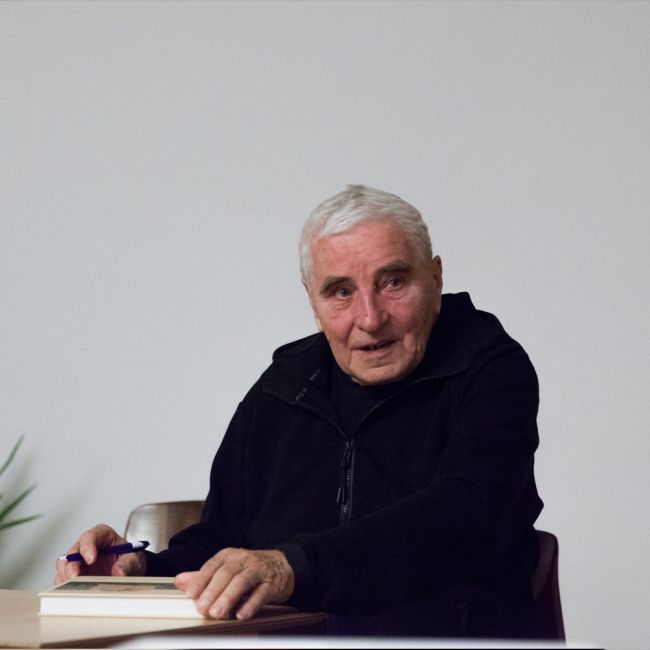
Juraj Gavula
Video in which Juraj Gavula speaks about his artistic and pedagogical work at the Academy of Fine Arts and Design in Bratislava is published in memoriam.
Juraj Gavula passed away on 13 February 2026.
Funeral Address by the Rector
20 February 2026, Bratislava Crematorium
In 1990, Juraj Gavula took up the position of university lecturer leading the Glass Studio at the Academy of Fine Arts and Design in Bratislava. At that time, he already had an extensive artistic practice behind him, as well as exceptional pedagogical experience at the Department of Stone Sculpture at the Secondary School of Applied Arts in Bratislava. To this day, many graduates still identify with this formative stage of their education.
Juraj Gavula entered academia at a time of widespread social euphoria following the fall of the communist regime. These were still revolutionary times, full of expectations, impatience, and an urgent need to present the results of one’s creative work, but also marked by efforts to rebuild the school’s individual departments. Juraj Gavula followed in the footsteps of his teacher Václav Cigler, who understood the school as a “laboratory of thinking and an environment for self-discovery.” After Václav Cigler’s departure in 1979, the Glass Studio stagnated for a decade. Juraj Gavula arrived at a time when it was necessary to restore artistic thinking, technological knowledge and skills to education, as well as to create space for presenting students of glass in the emerging small exhibition venues of that period.
It was not easy for him, as he was confronted above all with the existential necessity of rebuilding the entire glass department from scratch, including its technological equipment. Everything at that time was happening on the move, yet Juraj Gavula was able to withstand the complexities of the period as well as the transformation processes within the school. He was a person of quiet strength and inner stability, grounded in systematic and honest work, in a foundation based on respect for sculptural material and artistic thinking. He belonged to those teachers who instilled in their students the habit of daily studio work, encouraging them to find their own means of artistic expression and their own themes to develop over the long term. Juraj Gavula approached each student individually; the assignments he formulated for them were based on their creative potential as well as their practical abilities.
I value Juraj Gavula for his reflections on materials. He was able to speak beautifully about stone, wood, or glass. In his understanding, there was no hierarchical order among them; he saw artistry in the ability to understand material and its laws. Although he was a graduate of a glass studio, in his own work he preferred stone or wood for their broader possibilities of artistic expression. Not being bound to glass as a material is a value that says much about Juraj Gavula’s freedom. This kind of freedom he also encouraged in his students.
In addition to stone, he also loved wood. I remember him once mentioning that the first glassworks were established precisely in places where there was plenty of beech wood, which made it possible to melt glass. It is a very beautiful way of thinking about broader interconnections, not only artistic but also cultural and economic.
At the end of my address, I will allow myself a more personal note. Juraj Gavula taught my brother Dalibor in the stone sculpture department at the Secondary School of Applied Arts, and in recent days we have spoken about him often. He respected his teacher and was fond of him. He told me that there are teachers who are able, at a certain moment, to say a sentence that fits like a key into a lock. Juraj Gavula told him that what is beautiful about stone is that it does not allow deception, that stone does not forgive. This largely determined his further creative direction.
Juraj Gavula was an exceptional teacher and a very good sculptor; he was a gentle yet extraordinarily strong person. I admit that I do not like to recall the 1990s — they were harsh, loud, and rough years — but thanks to people like Juraj Gavula, they could be endured with humanity.
20 February 2026
Bohunka Koklesová